My research focuses on conscious perception.
Sensory perception has a curious subjective quality: we consciously experience the external world in a certain way and from our own personal perspective. Subjectivity anchors human nature. It is the vividness of a striking landscape view, the flavor of a favorite pastry, and the core of physiological and psychiatric suffering.
Understanding the mechanisms of subjective perception is arguably the bottom line in the field of perceptual neuroscience, but subjectivity is often overlooked in practice. For technical and conceptual simplicity—and with great success—many studies ask how the brain transforms sensory input signals into behavioral outputs in a strictly objective manner, with little consideration of the corresponding conscious experiences that define our vibrant inner lives.
I and others instead center the subjective: what are you experiencing right now? How might different neural and bodily processes influence your answer?
Ongoing and recent projects
Visual stability across eye movements

Although our eyes frequently jump around to sample different parts of a visual scene, we maintain a conscious sensation that the world is fixed in place. Strangely, existing measurements of brain activity predict exactly the opposite. Each time our eyes move, every brain region that encodes visual information suddenly and massively shifts its activity pattern—as if it were not the eyes that moved but the world itself. I am working to reconcile these disjoint signals with our stable, continuous visual experience.
Object recognition
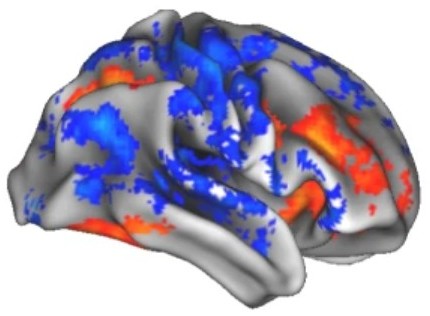
Consciously recognizing an individual object, such as a face, an animal, or a book, turns out to be a complicated task that involves several sensory and cognitive processes. Using ultra-high field fMRI (7 Tesla), Ella Podvalny and I discovered that the conscious experience of recognizing objects involves widespread activity across the whole brain, even including areas previously considered to be uninvolved with visual perception. This work has spawned a few follow-up studies (1, 2, 3) and I am currently investigating whether this whole-brain neural signature differs for different senses, such as sight versus hearing.
Constructive perception and illusions
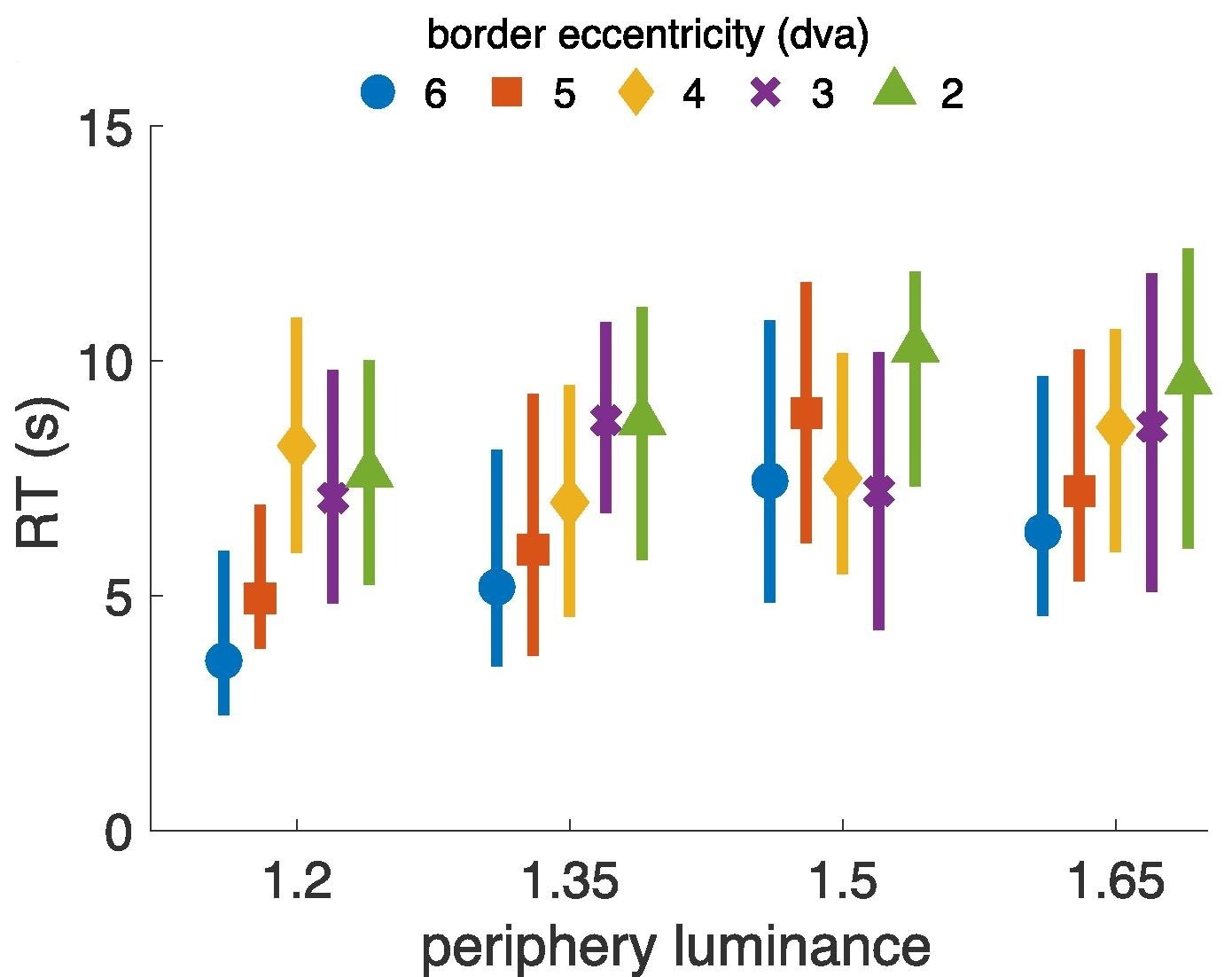
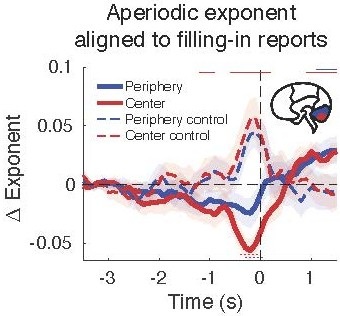
The contents of conscious perception sometimes change even when the external world does not. Perceptual filling-in is a simple illusion based on this phenomenon: when the eyes are kept very still, two adjacent colors can appear to blend together. This illusion demonstrates that our brains can construct inaccurate perceptual content from weak sensory input. My PhD experiments (1, 2, 3) helped to explain how this all works.